Effect
Liquid glass morph
Glass bodies behave like liquid: when they come closer than their merge spacing they fuse with a smooth neck; indicators stretch while moving; a button can swell into a menu.
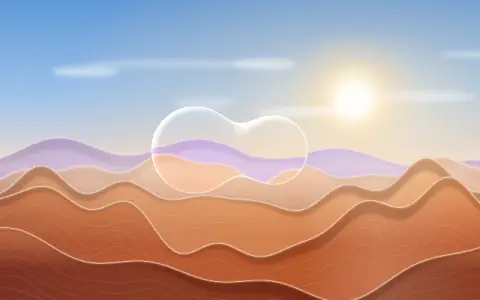
- Use in
- Transitions: tab/segment indicator travel, a floating button expanding into a toolbar or menu, grouped icon buttons merging, search field expanding.
- Avoid
- Permanent blobby shapes in static layouts; wobble that continues after the gesture; morph under reduced motion.
Parameters. merge spacing 12–24 px, spring 300–450 ms with 0.15–0.3 bounce, stretch up to 1.2× along the motion.
How it is built
- Design tool
- Smart Animate between frames where shapes overlap/merge; union the shapes with a large corner smoothing at the neck for stills.
- Web
- WebGL: smooth-union of shape SDFs (smin) feeding the same refraction. DOM: animate one glass body's width/position (transform) between targets instead of fading two.
Shader, in one line
float smin(float a, float b, float k){ float h = clamp(0.5 + 0.5*(b - a)/k, 0.0, 1.0); return mix(b, a, h) - k*h*(1.0 - h); } — use the merged distance for normal, bend and rim.Questions
Where should morph be used?
Transitions: tab/segment indicator travel, a floating button expanding into a toolbar or menu, grouped icon buttons merging, search field expanding.
When should morph be avoided?
Permanent blobby shapes in static layouts; wobble that continues after the gesture; morph under reduced motion.
How is morph built on the web?
WebGL: smooth-union of shape SDFs (smin) feeding the same refraction. DOM: animate one glass body's width/position (transform) between targets instead of fading two.