Effect
Liquid glass iridescence
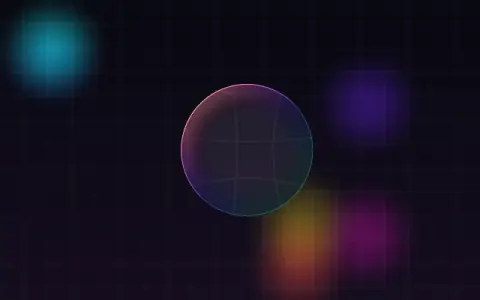
View-dependent rainbow sheen like a soap bubble or oil film: hues shift with the angle and thickness, strongest near grazing edges, usually over clear glass.
- Use in
- Decorative hero objects (orbs, AI/assistant spheres, badges, app-icon layers), selected hero states. Not for everyday chrome.
- Avoid
- Full-saturation rainbow fills on UI panels; iridescence behind body text; mixing it with heavy frost.
Parameters. film thickness 0.3–1.2 (normalised), strength 15–40 %, mostly in the outer half of the shape; animate slowly (8–20 s loops).
How it is built
- Design tool
- Angular gradient (cyan → magenta → yellow → cyan) at 20–40 % in Overlay/Color Dodge, masked to the rim region; add a soft specular.
- Web
- CSS: conic-gradient overlay with mix-blend-mode: overlay masked to the edge ring. WebGL: thin-film cosine palette driven by the view/normal angle and noise.
Shader, in one line
vec3 film = 0.5 + 0.5*cos(6.2831*(thickness*(1.0 - cosTheta) + vec3(0.0, 0.33, 0.67))); col = mix(col, col*film*1.4, strength * edgeFactor).Questions
Where should iridescence be used?
Decorative hero objects (orbs, AI/assistant spheres, badges, app-icon layers), selected hero states. Not for everyday chrome.
When should iridescence be avoided?
Full-saturation rainbow fills on UI panels; iridescence behind body text; mixing it with heavy frost.
How is iridescence built on the web?
CSS: conic-gradient overlay with mix-blend-mode: overlay masked to the edge ring. WebGL: thin-film cosine palette driven by the view/normal angle and noise.